Manufacturers wholesale various PTFE sheets
$ 18.00
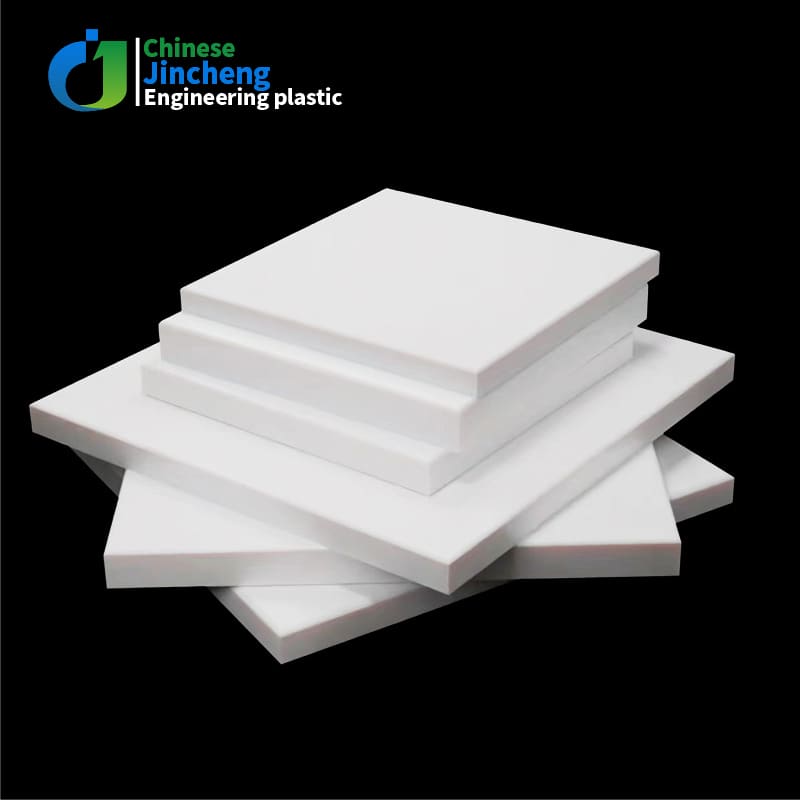
Polytetrafluoroethylene (PTFE) sheetProduct InformationPolytetrafluoroethylene (PTFE) plate is made by molding polytetrafluoroethylene resin at room temperature,followed by sintering and cooling.Color:white Size: Customizable Thickness: 0.5-120mmTechnical ParameterprojectCompanyIndicatordensityg/cm³2.1-2.3bending strengthMpa11-14tensile strengthMpa21-28friction coefficient/0.04Water absorption rate%<0.03Dielectric strengthKV/mm10Usage temperature℃-180~260Melting temperature℃325 Polytetrafluoroethylene (PTFE)sheet featuresHigh temperature resistanceLow temperature resistanceAcid and alkali resistantClimate resistantHigh lubricationNon adhesiveNon toxicInsulation propertiesHigh temperature resistance:The operating temperature can reach 250℃.Low temperature resistance:It has good mechanical toughness; even when the temperature drops to -196℃,it can still maintain an elongation of 5%.Corrosion resistance:It shows inertness to most chemicals and solvents, and can withstand strong acids, strongalkalis, water and various organic solvents.Weather resistance:It has the best aging life among plastics.High lubrication:It has the lowest friction coefficient among solid materials.Non-adhesion:It has the smallest surface tension among solid materials and does not adhere to any substances.The mechanical properties of it have a very small friction coefficient, only 1/5 of that of polyethylene.This is an important feature of the perfluorocarbon surface. Also, due to the extremely low intermolecular forceof the fluorine-carbon chain, polytetrafluoroethylene is non-adhesive.Non-toxic:It has physiological inertness and has no adverse reactions when implanted in the body as artificialblood vessels and organs for a long time.Electrical performance:The dielectric constant and dielectric loss of polytetrafluoroethylene are very low withina wide frequency range, and the breakdown voltage, volume resistivity and arc resistance are all relatively high. Radiation resistance:The radiation resistance of polytetrafluoroethylene is poor (104 rads). After being exposedto high-energy radiation, it causes degradation, and the electrical and mechanical properties of the polymerdecrease significantly. Applications Polytetrafluoroethylene can be processed by compression or extrusionmolding, it can also be made into an aqueous dispersion for coating, impregnation or made into fibers.Polytetrafluoroethylene is widely used in atomic energy, aerospace, electronics, electrical, chemical,mechanical,instrumentation, architectural, textile, food and other industries as a material resistant to high and low temperatures,corrosion, insulation materials,anti-stick coatings, etc.Atmospheric aging resistance:Radiation resistance performance and low permeability.Long-term exposure tothe atmosphere, the surface and performance remain unchanged.Non-flammability:The limited oxygen index is below 90.Acid and alkali resistance:Insoluble in strong acids, strong alkalis and organic solvents.Oxidation resistance:Can withstand the corrosion of strong oxidants.Acid and alkali property:It is neutral.The mechanical properties of polytetrafluoroethylene are relatively soft. It has a very low surface energy.Application fields of PTFE sheetPolytetrafluoroethylene plates are widely used in various fields. The following are some main uses ofpolytetrafluoroethylene plates:Electrical industry: In the electrical industry, polytetrafluoroethylene plates are used as insulation layers forpower and signal lines, as corrosion-resistant and wear-resistant materials.They can be made into films, tubes,plates, rods, bearings, gaskets, valves, and linings for chemical pipelines, pipe fittings, equipment containers, etc.Chemical industry: In the chemical industry, polytetrafluoroethylene plates are used to manufacture equipmentsuch as pipelines and seals to prevent the erosion of equipment by acids, alkalis and other chemicals. It can alsobe used as a diaphragm in reactors or as a lining for agitators to protect internal components from wear.Food industry: Due to its non-toxic, high insulation and non-adhesive properties, polytetrafluoroethyleneplates meet food-grade requirements and can be used for food equipment accessories, such as the inner layerof easy-to-clean water pipes.Medical and scientific research: In the fields of medical and scientific research, polytetrafluoroethylene platescan be used as containers for ultra-pure chemical analysis and the storage of various acids, alkalis andorganic solvents.Oil and gas industry: In the oil and gas industry, polytetrafluoroethylene plates are used for leak preventionduring oil well drilling, to reduce mud loss, and as films for lubricating materials, etc.Processing methods of polytetrafluoroethylene platesMolding method: It is by putting polytetrafluoroethylene resin into a mold and then sintering it at hightemperature and high pressure to make it formed.Pushing method: Involves heating and melting polytetrafluoroethylene resin using specific equipment andthen forming it.Machining method: Such as using equipment like lathes and milling machines for processing, suitable for moreprecise forming requirements.